Business transportation plays a critical role in the success of modern companies, especially for small businesses trying to grow in competitive markets. Efficient and affordable transportation solutions help employees travel comfortably, improve productivity, and reduce operational delays. However, many small businesses struggle with high transportation costs and limited resources.
In this article, we will explore affordable business transportation ideas for small businesses, along with practical strategies, cost-saving tips, and modern corporate mobility solutions.
Introduction to Business Transportation
Business transportation services refer to organized travel solutions provided by companies for employees, clients, or goods. These services include corporate shuttle services, executive transportation, employee commute solutions, and on-demand travel options.
For small businesses, investing in the right corporate transportation system can improve efficiency and reduce stress for employees who travel regularly for meetings, deliveries, or office commutes.
Why Business Transportation Matters for Small Businesses
Small businesses often assume transportation is only important for large corporations. However, reliable business transportation services can significantly impact growth and productivity.
Key benefits include:
- Improved employee punctuality
- Better time management
- Reduced stress for staff
- Enhanced brand professionalism
- Cost-effective travel planning
When employees have reliable transportation, they focus more on work instead of commuting challenges.
Affordable Business Transportation Ideas for Small Businesses
Below are practical and budget-friendly ideas that small businesses can implement:
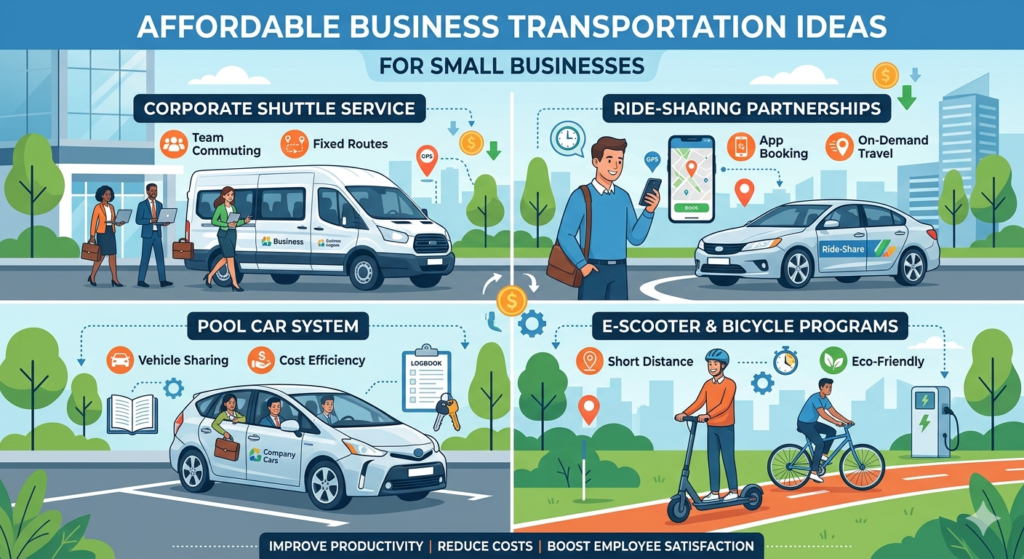
1. Shared Corporate Shuttle Services
One of the most cost-effective solutions is using corporate shuttle services. Instead of reimbursing individual travel expenses, companies can arrange shared vans or buses for employees.
Benefits:
- Reduces fuel and travel costs
- Encourages team bonding
- Environmentally friendly
- Efficient daily commuting
This is especially useful for companies with fixed office timings.
2. Ride-Sharing Partnerships
Small businesses can partner with ride-sharing platforms to offer discounted travel for employees. This is a flexible form of corporate transportation that eliminates the need for owning a vehicle fleet.
Benefits:
- No maintenance costs
- Pay only when used
- Flexible scheduling
- Easy booking via apps
This is ideal for startups and remote teams.
3. Pool Car System for Employees
A pool car system allows employees to share company-owned or rented vehicles for business travel.
Advantages:
- Reduces number of vehicles needed
- Lowers fuel expenses
- Easy management of travel logs
- Efficient for meetings and client visits
Small businesses can start with just one or two vehicles.
4. Hybrid Remote Work + Transportation Model
Not all employees need daily transportation. Small businesses can reduce costs by combining remote work with scheduled office visits.
Benefits:
- Less daily commuting cost
- Reduced transportation demand
- Increased flexibility
- Better employee satisfaction
This modern approach is becoming popular among startups.
5. Monthly Travel Pass System
Companies can provide employees with monthly travel passes for public transport or private services.
Why it works:
- Fixed monthly cost
- Easy budgeting
- Encourages use of public transport
- Reduces administrative workload
This is a simple and effective business transportation solution.
6. Bicycle or E-Scooter Programs
For short-distance commuting, small businesses can promote eco-friendly transport options like bicycles or electric scooters.
Benefits:
- Low cost investment
- Healthier lifestyle for employees
- No fuel expenses
- Environmentally friendly
This works best in urban areas with short travel distances.
7. Outsourcing Transportation to Third-Party Providers
Instead of managing vehicles internally, companies can hire professional business transportation services providers.
Advantages:
- No vehicle maintenance cost
- Professional drivers
- Reliable scheduling
- Scalable services
This is one of the most efficient options for small businesses.
8. Flexible Travel Allowance System
Instead of arranging transport, companies can give employees a monthly travel allowance.
Benefits:
- Easy payroll integration
- Employee freedom of choice
- No transport management stress
- Suitable for hybrid workplaces
This system is widely used in modern corporate environments.
9. Corporate Ride Pooling for Meetings
For client meetings or group travel, businesses can use ride pooling strategies where employees traveling to the same location share transport.
Advantages:
- Reduces travel expenses
- Improves coordination
- Saves time and fuel
- Efficient for team travel
10. Negotiated Contracts with Local Transport Providers
Small businesses can reduce costs by negotiating contracts with local taxi services or transport companies.
Benefits:
- Discounted pricing
- Priority service
- Reliable availability
- Long-term savings
This is a smart strategy for consistent travel needs.
Cost-Saving Tips for Business Transportation
To make corporate transportation services more affordable, small businesses should follow these tips:
- Track employee travel usage regularly
- Optimize routes to reduce fuel consumption
- Encourage ride-sharing among employees
- Use digital booking systems
- Avoid unnecessary business travel
- Compare multiple transportation providers
Proper planning can significantly reduce overall transportation costs.
Technology in Business Transportation
Modern corporate transportation solutions are powered by technology. Small businesses can benefit from:
- GPS tracking systems
- Mobile booking apps
- Automated scheduling tools
- Fleet management software
- Real-time route optimization
Technology helps improve efficiency and transparency in transportation management.
Challenges Small Businesses Face
While implementing business transportation services, small businesses may face challenges such as:
- Limited budget
- Lack of infrastructure
- Managing employee schedules
- Rising fuel prices
- Vehicle maintenance costs
However, with the right strategy, these challenges can be minimized.
Future of Business Transportation
The future of corporate transportation is moving toward:
- Electric vehicles (EVs)
- AI-based route optimization
- Shared mobility systems
- Eco-friendly transport solutions
- Fully automated fleet management
Small businesses that adapt early will gain a competitive advantage.
Conclusion
Affordable business transportation ideas for small businesses are essential for improving efficiency, reducing costs, and enhancing employee satisfaction. Whether it is shuttle services, ride-sharing, travel allowances, or outsourcing to professional providers, each option offers unique benefits.
By choosing the right corporate transportation services, small businesses can operate more smoothly and focus on growth without worrying about travel challenges.